
Do you know which skills your workforce needs to succeed in 2025 and beyond? 83% of HR leaders believe workforce demand is developing faster than workers’ skills, and technology is the biggest driver of change.
Digital workplace systems, business intelligence tools, cloud computing, virtual reality, and artificial intelligence have massively impacted many job profiles. The transition to renewable energy, advancements in cloud computing, and the adoption of digital twins and autonomous agents will further change how we work (and live).
Understanding what skills will be in demand in 2025 and beyond will help you future-proof your career or ensure your company has access to the right competencies.
TL;DR—Key Takeaways
- Candidates and employees need soft skills like adaptability, creative and analytical thinking, and management chops. They should also be equipped with technical and digital skills like AI, data analysis, software engineering, and cloud computing.
- Digital skills are in high demand as part of almost every job. Yet almost half of EU workers are digitally under-skilled. They lack the necessary digital competencies to do well in their current role and require upskilling to stay employable in the future.
- Apart from digital skills, the fastest growing skills between 2025 and 2030 will be creativity, advanced IT and programming skills, scientific research and development, advanced communication, and negotiation skills.
- A few of the highest-paying skills at the moment are roles relating to software engineering, data analysis, and project management. This is because AI and Machine Learning Specialists top the list of fast-growing jobs, followed by various green sector jobs.
- The top 25 skills in demand in 2025 include communication, management, emotional intelligence, leadership, teamwork, continuous learning, software engineering, AI, data analysis, financial management, operations, and UX/UI design.
- The top emerging skills of 2025 are prompt engineering, AI risk management, consultative selling, virtual collaboration, and green skills in sustainability management.
- To nurture a future-proof workforce, companies use skills assessments to find the right candidates at the hiring stage, identify workers with necessary competencies for internal mobility, and determine workforce upskilling needs.
What are the fastest-growing skills in demand, and why?
To understand the skills demand, you need to understand broader economic, technological, and societal shifts.
In 2010, most of us worked a 9 to 5 in an open-space cubicle. But in 2025 and onward, more and more teams will adopt hybrid or remote work. Top-down hierarchical organizational structures have become flatter, and more collaborative leadership styles are preferred. Diversity, equity, and inclusion (DEI), employee well-being, and ESG reporting are central priorities.
New technologies like cloud computing, blockchain, artificial intelligence (AI), and renewable energy production are changing how businesses work, how work is organized, and what employees are expected to do.
| 3 trends driving the demand for new skills |
|---|
| Technological: Emerging technologies require new technical competency and stronger cognitive skills. |
| Economic: Business cycles have become faster and the operating landscape—riskier, requiring a more agile workforce. |
| Environmental: Transition to renewable energy sources, sustainable manufacturing, and regenerative agriculture create high demand for new skill profiles. |
Because of these changes, a role description you saw (or signed for) eight years ago is no longer the same one you’ll see today or in five years.
Since 2016, 25% of job skills have changed, and by 2030, another 65% will further change.
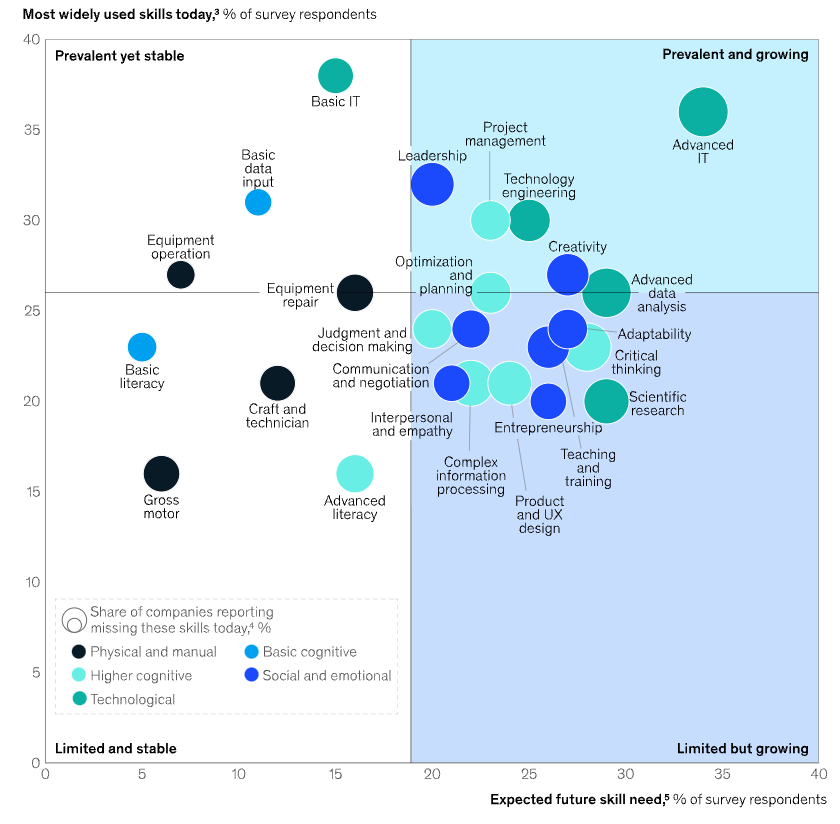
According to McKinsey, there’s a strong need for talents with better technological, cognitive, and social skills. Their predictions for top fastest-growing skills between 2025 and 2030 include:
| Basic digital skills | Advanced communication and negotiation skills |
| Creativity | Technology design, engineering, and maintenance |
| Advanced IT and programming skills | Interpersonal skills and empathy |
| Scientific research and development | Leadership and management |
Upwork also reports technical and digital skills are in high demand among employers hiring freelancers and fractional workers. Per their findings, the top 10 in-demand skills on the job market for 2025 are:
- Data analytics (also the fastest-growing)
- Machine learning (second fastest-growing)
- Data visualization
- Data extraction
- Data engineering
- Data processing
- Data mining
- Experimentation & testing
- Deep learning
- Generative AI modeling (third fastest-growing)
Skills gaps are more apparent in other areas, such as project management, data analytics, emotional intelligence, and cultural competency, as job descriptions change and new positions emerge. These trends create new talent market dynamics.
Employees find themselves in an hourglass-shaped labor market. For highly skilled individuals, a progressive work environment allows for greater autonomy and a better balance of work and family life. While the ‘squeezed middle’ of the workforce see jobs disappearing, low-skilled workers compete ferociously for positions (across all sectors).
The Future of Work. Jobs and Skills in 2030 Report
Without upskilling or reskilling, workers risk getting stuck at the bottom of the ‘hourglass’, especially as roles continue to evolve.
This is evidenced by the fact that, by 2027, almost half (44%) of workers’ core skills will be disrupted due to the effects of job creation and destruction from environmental, technological, and economic trends.
The World Economic Forum (WEF) predicts a loss of 83 million jobs, but 69 million new ones will be created. These new jobs come with a 44% change in a core skill set, per WEF, with a greater emphasis on:
- Creative thinking
- Analytical thinking
- Technological literacy
- Curiosity and lifelong learning
- Resilience, flexibility, and agility
- AI and big data
- Systemic thinking
- Motivation and self-awareness
LinkedIn’s research found that employers are seeking talents with strong interpersonal skills, such as communication, customer service, leadership, and management. The company also ranked adaptability as the fastest-growing skill over the last year.
Adaptability is on the rise because more and more work is becoming fractionalized. Roles are no longer limited to a narrow, itemized list of responsibilities. They have become cross-functional, assuming a continuous flow of evolving projects and tasks requiring a variety of skills and competencies. A data analyst may work with a marketing team for six months on a new go-to-market strategy, then get reassigned to help the finance department with some budgeting tasks.
We see a stronger convergence of tech and soft skills from multiple sources. Technology isn’t going away. On the contrary, it’s getting embedded into more and more processes. But automation doesn’t fully remove humans from the workplace.
No matter how ‘smart’ systems get, people still need to be present in the loop to supervise, tune, and program their performance. Moreover, future progress will require further innovation, and with that, skills like creativity, analytical thinking, data-driven decision-making, and strong people management will only become more important.
As Bernard Marr, best-selling author, futurist, and technology advisor to governments and private companies, puts it: “Success in 2025 will belong to those who can seamlessly integrate technological acumen with distinctly human capabilities.”
Fastest-growing data science & analytics skills
- SQL and NoSQL databases
- Apache Spark and Kafka
- Data pipelines development
- Data governance
- BI tools: Tableau, Power BI, and Looker.
- Data governance
- Advanced machine learning
In 2024, we’ve produced and consumed over 149 zettabytes of data. By 2028, global data volumes will increase by 2.6 times to 394 Zb. To transform raw numbers into actionable insights, business leaders need more people with strong data analytics skills. These include folks proficient in advanced machine learning and deep learning modeling techniques for real-time data processing.
Fastest-growing coding & development skills
- Python
- Java
- Javascript
- C/C++
- Typescript
- Cloud engineering
- API programming
- DevOps
- Amazon Web Services (AWS)
- Microsoft Azure
Spending on IT continues to grow year on year as companies rush to become digitally-native. With that, tech skills shortages will remain in the news headlines. IDC expects over 90% of global companies will continue to experience IT skills shortages until 2026. Choosing a STEM specialization or pursuing new coding certifications is a future-proof career choice.
Fastest-growing sales & marketing skills
- Marketing automation
- Email marketing
- Sales and business development
- SEO, SEM, and SMM
- Lead generation
- Digital marketing strategy
- Sales funnel management
- Framing and negotiation
68% of marketing professionals believe finding a new job today is more challenging than five years ago. However, candidates with in-demand skills in automation, marketing analytics, and digital campaign execution get competitive compensation.
Sales roles, too, now require more software knowledge. But ‘traditional skills’ like negotiation, rapport building, and effective framing still give candidates an edge on the job market.
Fastest-growing financial skills
- Advanced financial modeling
- Bookkeeping
- Statistical analysis
- Financial data mining
- Risk management
- Financial planning and analysis
- Data visualization
- Basic coding skills
Employers in the financial sector look for talents who bring a good combination of core competencies and adaptability. High volatility means companies seek resilient, analytical, and flexible professionals who can quickly respond to regulatory landscape changes and dips in economic indicators.
Aside from math and statistics skills, many financial roles also require basic coding knowledge or familiarity with low-code tools for data analysis and visualization.
Fastest-growing customer support & administrative skills
- Digital project management
- Market research
- Dropshipping and order processing
- Medical virtual assistance
- Supply chain management
- Customer relationship management
- Cybersecurity awareness
- Knowledge of automation and low-code tools
Customer support and admin roles are arguably seeing the biggest skill transformation. Technologies streamlined many common responsibilities like data entry, transcriptions, and invoice matching, typically done by admin staff.
Instead, operational staff is now expected to help with a wider range of project management, research, and business process optimization tasks. Customer service is also evolving from basic issue troubleshooting to a relationship-driven function, requiring people with strong interpersonal skills to create memorable customer experiences.
What are the highest-paying skills in demand right now?
Like any demand and supply situation in business, people with in-demand skill sets receive higher compensation.
Global talent shortages have reached a 16-year high, as 75% of employers can’t find the talent they need with the right blend of technical and soft skills.
Source
Despite massive layoffs, tech sector workers continue to enjoy high compensation. In the US, senior AI engineering and machine learning positions continue to offer salaries of $300,000. The median salary of a software engineer in the US also continues to sit at a lavish $161,433 per year.
Healthcare is another sector where talent shortages drive wage growth. In the UK, NHS nursing staff received a 5.5% pay rise and GPs — an extra 6% in 2024. However, unions also demand further pay grading from 2025 to 2026. In the US, healthcare employers are offering 20% higher pay to workers who’d agree to come on-site 4 to 5 days per week.
The British banking sector will offer the highest salary budget increase by 5% in 2025. Across roles, the US employers plan a 3.5% salary budget bump for 2025 and Canadian by 3.3%, according to Payscale.
Overall, if your goal is to make more cash this year, look into the following positions.
Technology
| Role | Average US Compensation | Average UK Compensation |
|---|---|---|
| Software engineering manager median compensation | $192,472 | £144,542 |
| Machine learning engineer median compensation | $166,665 | £95,950 |
| DevOps engineer median compensation | $141,446 | £75,975 |
| Data engineer median compensation | $132,940 | £71,071 |
Operations
| Role | Average US Compensation | Average UK Compensation |
|---|---|---|
| Program manager median compensation | $123,317 | £95,317 |
| Project manager median compensation | $136,363 | £80,575 |
| Business analyst median compensation | $128,604 | £60,089 |
Marketing and sales
| Role | Average US Compensation | Average UK Compensation |
|---|---|---|
| Marketing manager median compensation | $114,556 | £81,317 |
| Content marketer median compensation | $108,824 | £31,468 |
| Sales development representative median compensation | $79,354 | £63,720 |
Top 25 future-proof skills for 2025 and beyond
Before we jump into the meat, here’s a quick note on our methodology:
- To come up with this list of in-demand skills, we’ve analyzed data from the World Economic Forum, University of South Wales, KornFerry, LinkedIn, and McKinsey, among others.
- Additionally, we’ve examined anonymized skills testing data to understand the current dynamics and consulted our People Team for their insights.
With that in mind, let’s look at the top skills HR teams prioritize in workforce planning and what candidates need to have (or develop) to be in demand.
Soft skills
Soft skills, like communication, empathy, and adaptability, are just as important as tech savviness and core job-related skills. Even as tasks become more automated, strong collaboration, problem-solving, and organizational abilities will set apart top candidates.
Two-thirds of employers say soft skills are more important than educational qualifications in hiring.
Source
1. Adaptability
With faster business cycles, an expanded risk radar, and rapid tech disruptions, businesses prize people with strong adaptability skills. For 77% of business and HR leaders, flexibly moving skills between roles is critical for navigating future disruptions.
Therefore, companies seek people who can quickly respond to changes, try new approaches, think resourcefully,